Home Assistant
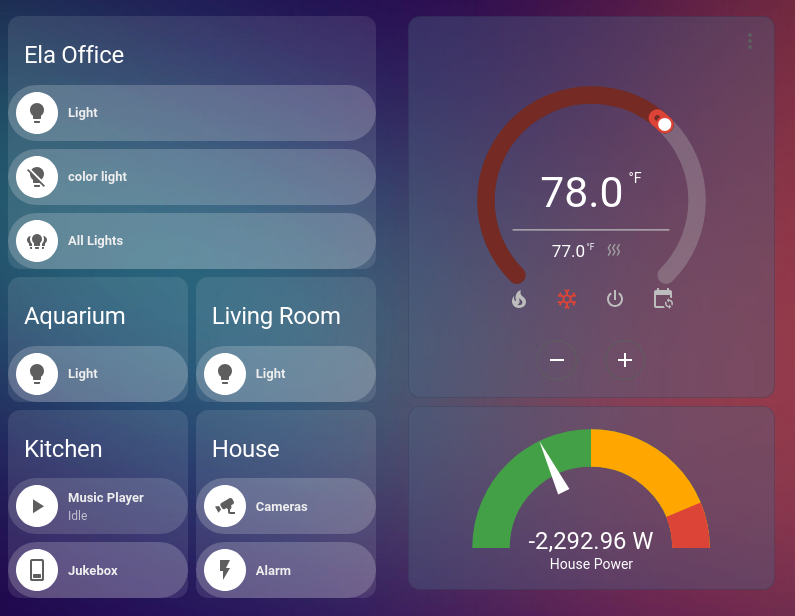
Every geek needs an “electronic home” – a home that is, at least in part, controlled by a computer. Over the last six years or so, I had “Lumosur,” my own computer-controlled home environment. It ran on a Raspberry Pi 3, controlled my lights and other devices, and included touch screens, voice recognition, and speech-to-text. It even had its own small programming language for automations and helpers. All of that worked without relying on a cloud service.
Still, it required flashing the Lumosur client software onto every device and didn’t support Zigbee or similar protocols. About a month ago, I decided to retire Lumosur and move everything over to Home Assistant.
Where to begin? Let’s start with the good parts. All the Zigbee devices I bought were recognized and configured immediately. The user interfaces are excellent, especially with the HACS Bubble extension. I rewrote part of my Honeywell integration code and had my alarm system working in HA within minutes. Webhooks made it easy to monitor my servers, including SMART checks for the RAID disks. My Asterisk phone system is now also monitored through HA. Cameras work. Energy monitoring works. Voice recognition, text-to-speech, even tying in my “tin-brain” LLM turned out to be manageable. I remain impressed by the amount of work people have invested in the platform. Almost everything runs smoothly, although a few areas feel less polished.
To be completely honest, I probably couldn’t have set everything up without AI assistance. There are many details, configurations, and small adjustments. Some things go into configuration.yaml. Then there are helpers, integrations, and automations. Whoever decided that indentation should define structure in configuration files probably deserves a quiet corner somewhere. It reminds me too much of COBOL. I never warmed up to Python for that reason. After more than thirty years of writing C, dealing with interpreters that care about spaces and tabs make me sick, and YAML follows the same pattern.
Lumosur used a JavaScript-style automation language. In Home Assistant, YAML snippets appear in several places. It can feel scattered and confusing. Another complication: parts of HA evolve quickly. When I searched forums or asked AI for help, some answers no longer matched the current reality.
Voice satellites turned into a good example. After watching a fairly recent video showing how to set up a Wyoming satellite, I grabbed my old Lumosur Raspberry Pi with the 4-mic USB ReSpeaker and started the setup. The expectation was a quick afternoon project. Instead, Wyoming had been deprecated. The old Python scripts no longer work with newer libraries. The replacement is the “Linux Voice Assistant.” That’s fine in principle, but the documentation left a lot of gaps, especially for a bare-metal Raspberry Pi installation. I eventually pulled the Git repository and spent a day or two sorting things out. I shared the solution on GitHub of course. During the discussion I was told that this is “a new bleeding-edge experimental project in a very early development stage.” Fair enough. Still, the earlier Wyoming environment was simple to install and worked reliably, so keeping it around while the new system matures might have eased the transition.
So there is a bit of hesitation in the back of my mind. Will my carefully built HA environment continue working long-term, or might something disappear after being deprecated? It’s hard to tell.
Overall, Home Assistant offers a powerful modern platform that can do almost anything locally, without cloud dependence or unwanted ties to walled gardens. Getting past the basic on/off automation stage requires patience and a lot (a lot!) of learning. With effort, the interface can look clean and impressive, though that also has a steep learning curve. And yes, there remains the possibility that a component changes direction and brakes things. Reaching the platform’s full potential often involves third-party tools and integrations.
For now, though, I am enjoying what Home Assistant can do. If challenges appear later, I’ll deal with them then.
Michaela Merz is an entrepreneur and first generation hacker. Her career started even before the Internet was available. She invented and developed a number of technologies now considered to be standard in modern web-environments. She is a software engineer, a Medical Rescue volunteer, an Advanced Emergency Medical Technician, a FAA Part 61 (PPL , IFR) , Part 107 certified UAS pilot and a licensed ham . More about Michaela ..